 The Double Life of Cedar Apple Rust
By Michael Rosenbusch
I remember very clearly the first time I saw one in person. It was one of those classic New England days;
early spring, cold, and raw. It had rained all night, and in the morning as I was walking through a misty grove
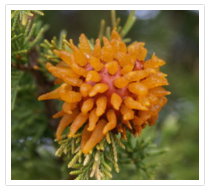
of eastern red cedars I saw the amazing spore bearing structures of cedar apple rust. They looked like orange golf
balls covered in sticky tentacles hung like Christmas ornaments in the trees.
The aptly named cedar apple rust has two hosts, members of the Malus (apples) genus and members of the Juniperus
(cedars) genus. Cedar apple rust spends the winter in lumpy structures it creates called tilial horns on the stems
of junipers. The fungi lay dormant until one special day in the spring when temperature and humidity are just
right. The sticky golf balls produce spores called tilospores. Tiliospores can only infect apples. As the
tilial horns dry the tiliospores are forced out to drift on the breeze and infect apples. At the spot of infection
a lesion forms, as the season progresses the lesion grows to about the size of a pea. During the spring the
lesion thickens, and by early summer ¼ inch tubes form on the bottom of the leaf, similar structures are also
produced on infected fruit. To the naked eye the tubes look almost furry. These structures called aecia produce
the aeciospores that infect junipers and complete the organism’s life cycle. The infected cedars are not harmed by
the fungi; it is the apple stage where serious damage can be done. 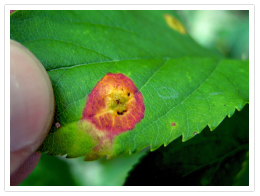
Like most fungal infections the three most important factors governing its spread and severity are host
susceptibility, weather, and in the case of rusts, the presence or absence of alternate hosts. There are many
varieties and cultivars or apple that are resistant to cedar apple infection and that is great if you are picking
new plants, but it doesn’t help your existing trees. The weather is hugely important to the development of cedar
apple rust.
Like most fungal infections cedar apple rust needs a moist leaf surface to germinate. Cool, wet,
overcast springs favor outbreaks of fungal disease. We can’t control the weather, but you the homeowner can help
by insuring good air flow around your trees. Pruning and culling trees around your prized apples, as well as the
apples themselves will increase air circulation and slow the development of the pathogen. Because cedar apple rust
needs junipers as its alternate host an effective way to mitigate infection is to remove junipers from your
property. This strategy is of course not always practical, but it may be possible to at least remove junipers
growing close to or under your apples.
Cedar apple rust is an interesting organism, but it can also be highly destructive. Cedar apple rust blights
leaves and ruins fruit. Heavily blighted leaves will die and drop from trees. Repeated years of infection can
lead to tree decline and death. Cedar apple rust is a fact of life, but with proper knowledge, and timing it can
be controlled. The best strategy for protecting your plants is to have a comprehensive Integrated Pest Management
program. A combination of cultural controls, understanding of the fungi’s life cycle, and prudent protective
applications will ensure not only the health of your apples, but your landscape in general.
|